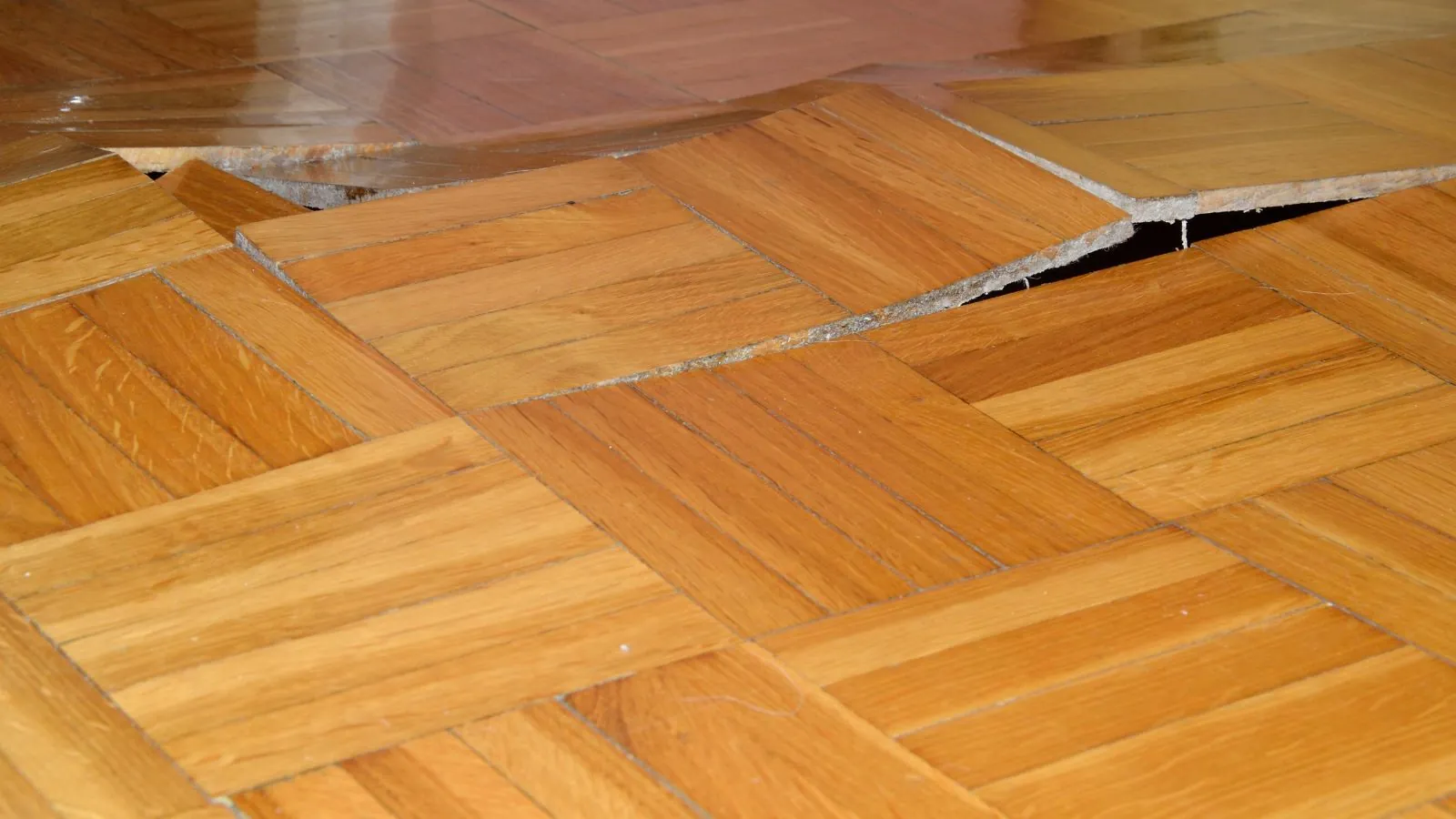
Hardwood floor water damage is the swelling, cupping, crowning or buckling of wood and laminate flooring after it absorbs water. In Derby, KS, a washer valve, a condensate line or a pipe in the wall can wet a floor without you noticing, and by the time the edges rise the subfloor is also wet.
The goal of repair is to dry the floor and what lies under it before the boards lose their shape.
Mop up the surface water, move furniture and rugs off the floor and keep the area ventilated. Do not cover the boards with plastic, which traps moisture. Call dispatch so a crew can check the floor and the subfloor with a moisture meter.
Wood floor damage: why timing matters
Boards take on moisture from the bottom and the edges. Early drying in the first days gives the boards the best chance to flatten, while weeks of dampness bring staining and finish failure. Dispatch is open 24/7, and a same-day visit is possible when a crew is free.
What water does to wood
Cupping is when the edges rise higher than the center, which happens when the underside is wetter than the top. Crowning is the reverse and can follow a drying floor that was sanded too soon. Buckling is when boards lift from the subfloor, usually after a heavy soak. Laminate swells at the seams and rarely returns to shape.
Solid hardwood is more forgiving than engineered or laminate. The depth of the wear layer matters because a thin layer limits how much sanding a floor can take.
Signs the floor is still wet
- Boards that feel raised at the edges when you run a hand across them.
- Gaps that open at the seams or a floor that sounds hollow.
- A musty smell near a baseboard.
- A darkening stain that spreads.
- A meter reading that stays above your dry reference after days.
How the drying works
The crew measures moisture in the boards and the subfloor, then sets a drying plan. Floor drying systems pull air through mats or hoses laid over the boards, and dehumidifiers lower the humidity so the wood can release water. Some jobs need a few boards removed to open a path for airflow.
After drying, the floor may flatten on its own over weeks. If not, sanding and refinishing can follow, or replacement of badly warped boards. The drying methods are described on the structural drying page.
Floor type and likely outcome
| Floor type | Water response | Likely outcome |
|---|---|---|
| Solid hardwood | Cups slowly, can recover if dried | Dry, wait, sand and refinish |
| Engineered wood | Layers can separate | Dry, then assess, replacement possible |
| Laminate | Swells at seams | Often replaced |
| Parquet or glued wood | Lifts in sections | Section removal and replacement |
Where hardwood water comes from
A washer valve that fails, a dishwasher that leaks onto the floor and a cooling system condensate line are the usual causes. The appliance leak page covers appliance failures, and the AC leak page explains how a condensate line can damage a floor. Wood over a wet crawl space can also cup from below.
What affects the cost
You get scope and price before the first board is lifted. Drivers include:
- Floor species, thickness and whether it is solid or engineered.
- Square footage that got wet and how many rooms.
- Whether the subfloor needs drying or replacement.
- Drying days and equipment.
- Sanding, refinishing or replacement.
A sudden leak onto a floor is often covered, while repeated wetting or a long leak often is not. Check your policy and talk to your insurer about the wording. Dispatch can give you a number once you describe the floor.
Wood floor wet or lifting? Call dispatch before the damage sets in.
☎ Call (316) 535-3098Sanding and refinishing afterward
Once boards are dry and flat, sanding and refinishing can restore a floor. Slight cupping often relaxes as moisture leaves, but refinishing too early can lock in a wavy surface. Wait for moisture readings to match the dry parts of the floor, and then plan sanding.
If boards are cracked or permanently warped, replacement of those boards is the usual fix. Ask the flooring contractor about matching stain and grain.
What not to do to wet hardwood
Do not use heat guns, do not cover wet boards with plastic and do not sand until readings are normal. ANSI/IICRC S500 describes how wood floors are dried and monitored, since boards can look dry on top while the underside is wet.
Common questions
Can a cupped hardwood floor be saved?
Often, if it is dried soon and the cupping is mild. Give the boards time, since they may flatten over several weeks as they release moisture.
How long should I wait before sanding?
Wait until moisture readings match your dry reference, otherwise the boards can crown later. The crew can read the floor and tell you when it is ready.
Do you handle wood floor emergencies at night or on weekends in Derby?
The line is open 24/7, and a same-day visit is possible when a crew is free. Early action protects the boards.
What if the floor is laminate?
Laminate swells at seams and often cannot return to shape, so replacement is more common. A moisture reading still tells you how wet the subfloor is.
Wood or laminate floor wet or lifting? Call dispatch and ask for a moisture check.
☎ Call (316) 535-3098